


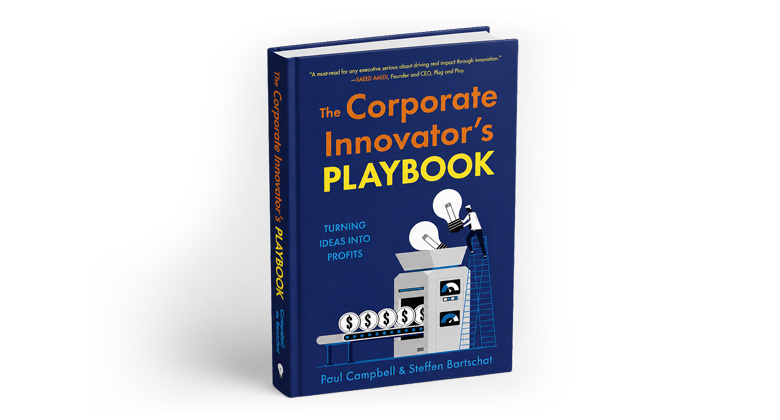
Paul Campbell and Steffen Bartschat, Authors, 'Corporate Innovator's Playbook'
Paul Campbell (MBA, Chicago Booth), pictured on right, is a global innovation leader who has built multi-billion-dollar businesses for companies like HP, Philips, Schneider Electric, and W.L. Gore. As Chief Innovation Officer, he drove capital efficiency and R&D returns, guiding leadership teams to foster cultures that accelerate innovation. Paul has launched new products and business models in health wearables, medical devices, PC gaming, and consumer electronics. He is a Professor of Practice at Hult International Business School San Francisco, teaching innovation and entrepreneurship, and has served as a guest lecturer at UC Berkeley Haas and Senior Advisor to the World Economic Forum.
Steffen Bartschat (BS, MS Carnegie Mellon, MS Stanford Business School), pictured on left, has lived and worked in Silicon Valley for over 30 years, initially as a senior engineering executive at IBM and Electronic Arts before shifting to the startup world. While serving as COO at wearable startup Lumo Bodytech, he advised $20B automotive supplier Faurecia on its Silicon Valley strategy. Steffen now runs a consulting business helping corporates improve their innovation strategies and helping startups grow their business. He is an active angel investor and has served as Board Director for one of his portfolio startups.
1. Why is The Corporate Innovator’s Playbook relevant and required reading in today’s high-velocity, growth-mandated market?
CIP: With AI tools aplenty, corporate growth leaders are re-establishing growth/innovation programs to pursue new opportunities. However, they know restarting a program with traditional approaches won't work today. Execs tell us, 'we tried that before and it didn't work'. CIP shows growth-minded leaders how to 'go far enough' in the pursuit of growth and deliver real impact.
2. How is embedded AI on-demand transforming the role, deliverables and value of the Chief Innovation Officer in the enterprise?
CIP: Enterprises have been deploying AI at Tiers 1-2 (Platforms that reduce Drudgery, Applications that delivery Decisions (e.g. for text-rich functions like Legal, Compliance, Market Rsch). But few are finding AI solutions for Tier 3 (Discovery/Growth). Tiers 1-2 are the domain of IT while Tier 3 is the domain of the CInO but their team is challenged to test and deploy AI solutions given all of IT's constraints. CInO's are reimagining new approaches to utilizing AI and deliver real impact, such as AI-as-a-Service (AIaaS), where no internal data is shared or IT systems linked. This approach is certainly being utilized during the initial phases when CInO's validate solutions/data sets. CIP shows leaders how to overcome barriers in both adopting new approaches with AI and pursuing new growth opportunities that emerge. AI has the opportunity to reduce the cost of identifying and pursuing new opportunities that could fundamentally change the competitive/market/industry dynamics for a company. CInO's need to lead their companies on this journey!
3. What are the leading causes of “innovation suffocation” and “acquisition subjugation/failure” in large organizations?
CIP: This is the core thesis of our book, how to identify and overcome corporate resistance to change, even when the change is the pursuit of emerging growth opportunities. We lay out a framework, Innovation Canvas, that identifies 10 innovation areas that leaders need to align inside their companies for true growth to happen. The framework helps leaders identifies the specific root causes at theircompanies, not generic causes for all corporations or industries. We call them 'blind spots', but they include support functions (e.g. HR, Finance, IT, Supply Chain, etc) that won't modify practices to accomodate new business models, etc, and business units that won't accept a transfer of a new business that's dilutive. Our research shows that these are the two biggest challenges in large companies: 1) BM innovation and 2) scaling up promising opportunities. Which is crazy, given the imminent impact of AI (see #2 above).
4. With treasure troves of data, analytics and insights, why are new product failure rates still so high? Some consultants estimate more than 70 percent.
CIP: Large companies optimize their NPD/NPI efforts on the wrong opportunity. Once they identify an unmet customer need and find PM fit, they then make a fundamental mistake, they get greedy and broaden the product concept to reach more customers at the start. A classic story is the consumer electronics company that knows from research that consumer love productss that are either black or white in color. So they decide to target both segments with one product that is gray, which of course fails terribly because it isn't attractive to anyone. As silly as this example is, we see it all the time. In our book, we call this the 'gravitational pull' of the core business. Companies can't help but pursue opportunities that are very large with existing BM's, and so they reshape promising opportunities so much that it is no longer going to succeed. Instead, corporations must be willing to discover, experiment, launch and grow new businesses in one function, Innovation, while chasing core businesses elsewhere.
5. What does it take to develop a reliable, predictive and recurring Innovation Funnel? How will adoption of the Innovation Canvas framework create a foundation for this?
CIP: they don't do enough. they write a strategy that says they'll get x% of growth from emerging tech/businesses, and they think it will just magically happen. Instead, once the strategy defines growth opportunity spaces, the innovation function must explore multiple pathways to realizing that growth, meaning establishing a subset of Open Innovation and Venturing capabilities, Greenhouse, custom policies from support functions (e.g. HR, IT, Legal, Finance), and so on. These capabilities are needed not to create a funnel, but to turn promising opportunities into real, scalable businesses. And most companies compartmentalize the job of creating a healthy funnel (Innovation) and scaling them (BU's), which is problematic. Instead companies need to combine exploration, creating a healthy funnel and scaling promising opportunities. We cover this topic in the Greenhouse chapter and go into detail about why this is so important (J-Curve dynamics).
6. Why do new category insurgents, contenders, disruptors and intruders outperform incumbent market leaders on the product innovation front?
CIP: In short, new entrants understand customers better. They practice Design Thinking (customer centricity) to identify unmet needs and then create unique solutions (PM fit) that are not constrained by existing/core business models.